Knife Upgrades

It has come to my attention that since I’ve worked at Sur La Table for going on a year and a half, that people assume my kitchen is full of top-of-the-line products. Not so! Surprisingly most of my paycheck actually does come home with me (as opposed to being spent at work). We are still using more or less everything we registered for when we got married in 2010. Most of the stuff we were generously given was good quality, and replacing it would be an exercise in needless expense. I’m so grateful for this fact!

That said, the knife set (Farberware, not carried anymore; see similar) that we were given is good, not great. I knew nothing about knives when we registered at Target so I signed up for one that included LOTS of knives. Just in case, right? I it’s a 20-piece set (includes 8 steak knives), which is HUGE for a knife set! After 3 years, some were getting a little dull, so last spring I took them to work and got them re-sharpened. They were good to go for a while longer, while I decided what I really wanted to get. Some of them are developing brown patina spots, and that’s our own fault for putting them in the dishwasher (see the end of this post for knife care tips).

After much agonizing, I finally decided to make a few upgrades to the knife corral. Here’s my lineup before upgrading… a photo I took so I could visually see what I was working with, and do some brainstorming.

My Knives, Before

Many chefs will tell you that a person needs three good knives in their kitchen. A chef’s knife, a paring knife, and a bread knife (with serrations). I like having a bit of a larger arsenal, but overall I agree with this rule of thumb. Therefore, some of my good not great knives are perfect for less-frequent, specialty jobs.

This meant that I wouldn’t need to replace my:

  • Cleaver (far right). Pretty standard, nice and heavy. Does its job well.
  • Carving set (center). Believe it or not I rarely make poultry or roasts that need to be carved. ;) These are in fine shape.
  • Bread knife (long, serrated). In my opinion, all bread knives are pretty similar. Not a splurge-worthy area.
  • Miscellaneous knives (far left). The yellow one was a gift from J.A. Henckles, from attending a training event for work. It is wicked sharp! The gold one’s brand is Kuhn Rikon. It’s also wicked sharp, and cheap. You may recognize it from my sister’s food-themed bachelorette party favor bag.

The knives on the chopping block (pun intended) were my:

  • Chef’s knife (2nd from right). The most-used kitchen knife, I was ready for something sharper made of higher-quality steel.
  • Santoku (3rd from right). My second-most used kitchen knife, I use a 7″ santoku for most fruits and vegetables.
  • Paring and utility knives (3rd and 4th from left). Using the yellow-handled knife has me spoiled! A longer utility of equal sharpness would be amazing.

Since I finally had a chance to pull out my knives all at the same time and evaluate them, I was able to make a decision on what new knives I would get without getting overwhelmed. Now, the knife block boasts two newbies!


Knife Block

Shun Sora and Global

I chose a Shun Sora 8″ chef’s knife and a Global 5.5″ nakiri to replace my chef’s knife, santoku, and utility knife. Two in, three out! I got Japanese knives since they are sharper and more precise than German knives (which the rest of mine are), and they will keep their sharp edge longer. I plan on doing a more in-depth review on these two, and a quick and dirty rundown on Japanese vs. German cutlery later this week. It’s too much info to squeeze into this already-long post, but it will go a long way towards helping anyone make an educated purchase of their own knives. Oh yes, and I promised you some tips to keep your cutlery in top shape:

Tips to make your knives stay sharp and last longer:

  • Use a honing steel to maintain the edge of the blade regularly. This allows you to go longer between sharpenings.
  • Don’t put knives in the dishwasher! Harsh surfacants in dishwasher soaps can damage the micro-sharp edge.
  • Don’t let them sit in water (in the sink, in a puddle on the counter). Brown rust patina spots can develop. Keep your knives dry!
  • Store them in a wooden block, on a magnet, or with edge guards in the drawer. This protects the blade, and your hands!

Do you have a favorite knife brand? See you later this week for more knife talk! 

Yummy DIY Ice Cream!

Well, we went ahead and did it! A couple months ago, inspired by a few friends of ours, Doug and I bought an electric ice cream maker (this model). I had never thought of really making ice cream at home before, but ever since I started demonstrating this very machine at work–I realized how easy it is! Home-made ice cream is a great option for those who like to experiment. Overall, as long as you add enough heavy cream or half and half, plus lots of sugar, the sky is the limit when it comes to adding flavors and mix-ins.

Strawberry Ice Cream

Our first foray into ice cream making was a standard strawberry recipe from the booklet that came with the machine. However, I tweaked it a bit:

Instead of mashing the strawberries, I pulsed them in the food processor so that the juices were released but there were plainly still small strawberry pieces–the strawberry pieces froze wonderfully and add a sort of satisfying crunchy texture to contrast with the smoothness of the rest of the ice cream. Also, we subbed in a tablespoon of hot chocolate mix where it called for vanilla extract (since we were out of vanilla). With this particular batch, we froze it overnight, which gave it a harder consistency. I preferred that to straight out of the machine. Other varieties taste awesome straight from the machine–a little more like soft-serve.

One thing I noticed about making our own ice cream is this: it really encourages a person to eat less. I mean, pouring in two cups of heavy whipping cream really makes it hit home–this stuff is not healthy! The process reminded me of an article I read about cooking vs. purchasing processed food. The quote that came to mind was–

“Special occasion foods become every day foods when we let industry cook for us.” (One example Pollan gives is french fries or chips. They taste great when you cook them yourself, but the process is highly labour intensive(washing, peeling, cutting, pan, oil, splattering, oil, washing up etc) so left to our own devices we might eat them only every month or so as a treat, but many Americans now eat two batches of french fries a day because they have become so convenient.) … The diet that would work for everybody is: eat anything you like, just cook it yourself.

Does that make sense? Since I know exactly what is in my ice cream, I can enjoy the delicious, indulgent fruits of my labor, but the size of the scoop I serve myself will definitely be smaller than a scoop that Ben & Jerry’s would serve me!

Either way… I plan on making lots of yummy ice cream at home for the last few weeks of summer, and well into fall. Can anyone say pumpkin chai ice cream??

Colorful Kitchen Inspiration

To wrap up my week dwelling on things you can put in your kitchen, both essential and trivial, I thought I would take a trip to fantasyland for a little while and share some wonderful colorful kitchens I’ve pinned on Pinterest.

Every few days, I’ll check the apartment rental market and the condo sales market in San Diego just for fun. I see so many boring flipped kitchens with the same old predictable colors and finishes. These are so different and so exciting! No cherry cabinets with black granite countertops here! (Can we all agree that that combination comes off very heavy?) Experimenting with color is also an inexpensive way to freshen up a kitchen while saving the big bucks for a full kitchen overhaul a few years down the line.

Click each image to be taken to its website.

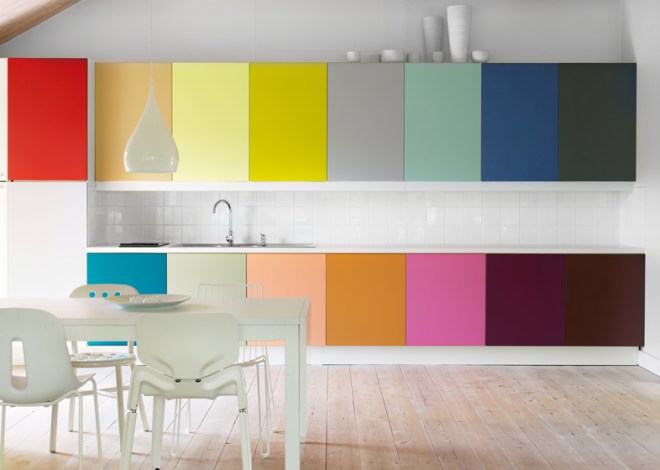
Color Cabinets - Photo by Magnus Anesund

The first time I saw this picture, I was so excited that I dragged Doug over to the computer and made him check it out. One must really be a color expert to pull this off because bright colors, if they aren’t tempered with enough gray and brown, can look circus-y really fast. It works sooo well here because everything else is white, white, white. Even the floors have been whitewashed or limed to achieve the white wood effect. I would love to see this in a commercial space setting.

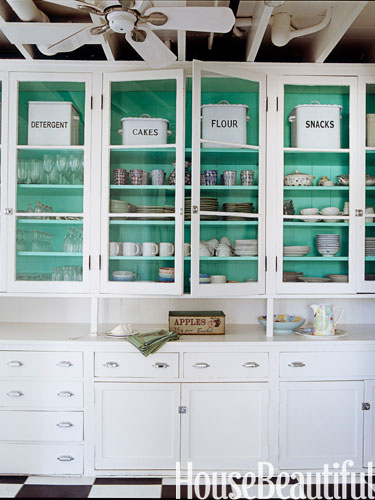
House Beautiful

This is an easy project anybody nervous about committing to color can handle. Don’t want to make an irreversible mistake on the cabinets? Painting the inside of the cabinet is really easy to change when the mood strikes.

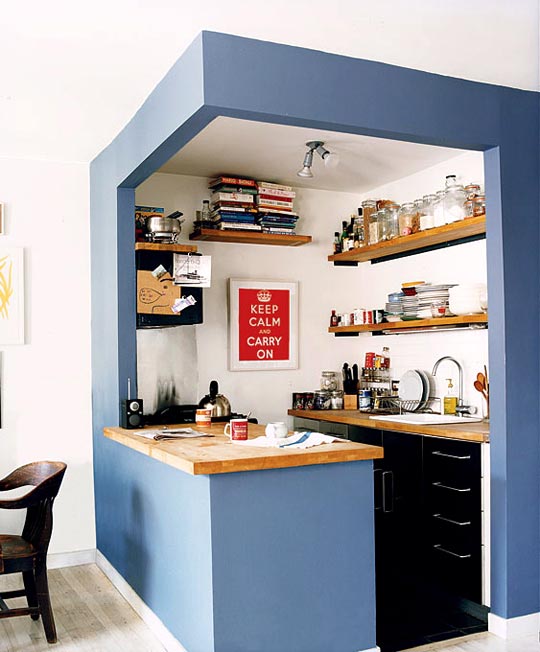
Blue Kitchen Space

I love the way the smallness of this kitchen is celebrated. I feel like if the blue walls were white, the area would seem even smaller–with the bold shade of blue, the area is like, “I’m here, I may not be huge but I’m stylish. Now cook amazing meals here.”

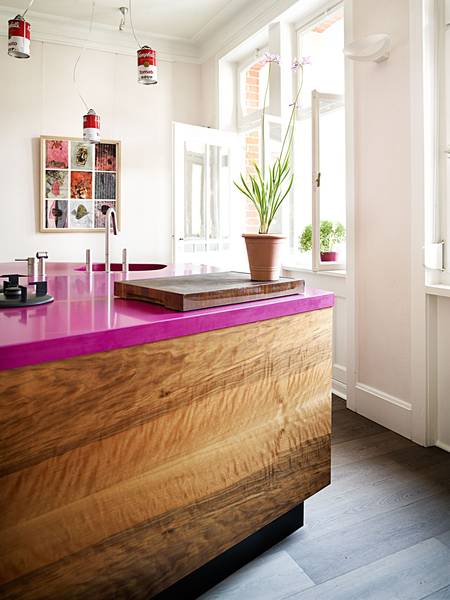
Ursula Mayer for Schorn & Groh.

How about bringing the color into the room via countertops? What an unexpected punch of color! Plenty of retro kitchens have tile accents on the counter, but this sleek slab of pink is absolutely scene-stealing!

I feel like a kitchen that’s exciting to simply be in would be exciting to cook in. Let the creativity flow!

What do you think? Would you take a big color risk in the kitchen?