DIY Plywood Headboard

First, I want to thank you all for your kind words about Doug’s stolen bike on Monday. I was also pleased and surprised with the number of comments on the bedroom! It is a great week to be a blogger. :)

File this project under “got it done!” or “procrastination who?”

When Doug’s brother was here in San Diego last week, we hit up the Urban Outfitters downtown to see if they had any winter coats on clearance (they didn’t). While we were there, Matt, who does woodworking, took a particular interest in the fixtures which were made of mainly plywood, 2’x4′ lumber, and pipes! (Related: I found an interesting article on UO’s aesthetic.)

When pondering bed solutions, I realized that using the same materials, I could create a modern, fresh, E-A-S-Y, and cheap headboard.

I got some leftover plywood (the type I used is technically called OSB, or oriented strand board) from my dad’s garage–these pieces were actually left over from when my parents’ house was built in 1999. Vintage!  This kind of wood is normally used as a subfloor or other non-finished construction material.

The goal was to make a headboard 60 inches wide (queen size) and somewhere around 4 feet tall. As luck would have it, the boards my dad gave me were in 20″x48″ panels which means we had no cuts to make whatsoever! We did have to drop about $12 at Lowe’s for the other lumber. I will not say no to a $12 headboard.

Supplies needed:

  • Plywood (OSB) panels
  • One 1″x4″x8″ board, cut into two 4′ pieces
  • One 1″x4″x10″ board, cut into a 60″ piece and a 52″ piece
  • Screws
  • Cordless drill(screwdriver)

The plan was to line the boards up and brace them with lumber from behind–one piece down each side and two braces horizontally. Here’s a shot snapped in Lowe’s after we had our boards cut for us:

headboard frame

Originally I wanted to attach the screws in from behind but after some trial-and-error, and taking into account the way the OSB board would splinter, we decided that having exposed screw heads on the front was not the end of the world. At least I measured evenly and marked the board with sharpie so they would all line up. Here’s a progress shot–he is working on the bottom of the board:
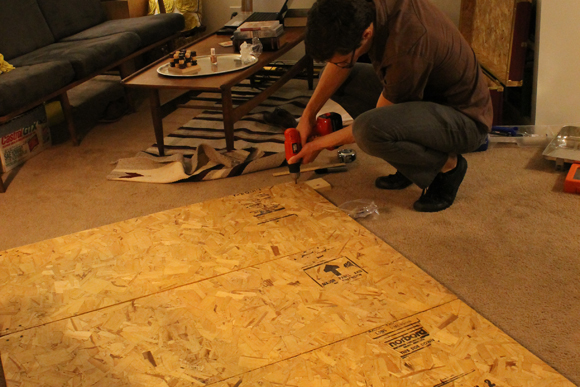
headboard in progress

Note: we had already been to the hardware store twice that day and did not want to go out again to buy the appropriate length of screws. The drywall screws we used were too long and stuck out the back of the headboard!! I took this opportunity to break out the dremel tool we have had for several years and use the heavy duty cutter attachment to cut off the ends of the screws that were sticking out. Disclaimer: I do not recommend doing this unless you have a workshop. I did this on the apartment patio and it kind of scared the pants off me.

using a dremel

dremel-ed off screw ends

So as not to damage the walls, since the screw tips were still not flush, we covered the tips with two layers of painter’s tape. Another good option (that I still might use) is felt circles–the adhesive kind you can put on chair legs so they don’t scratch the floor.

Enough blabbing, let’s see some “after” shots!
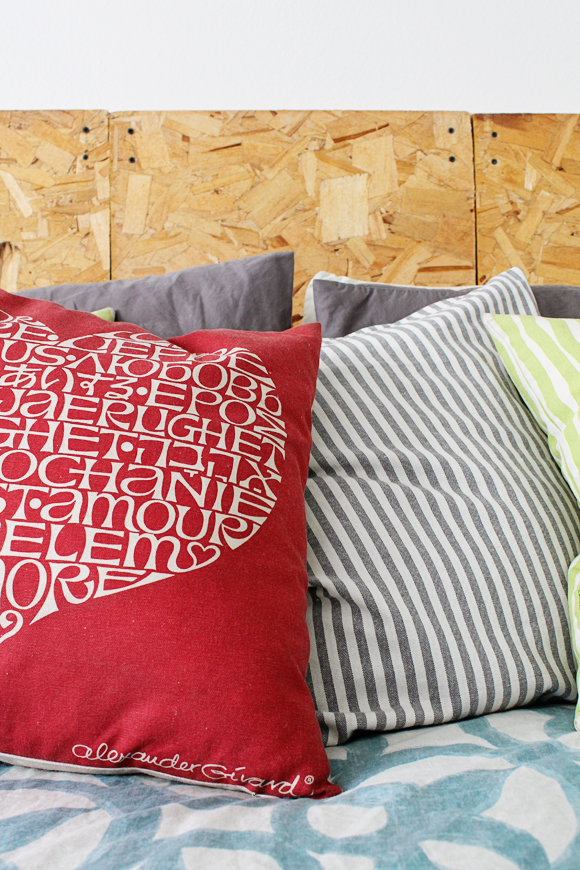
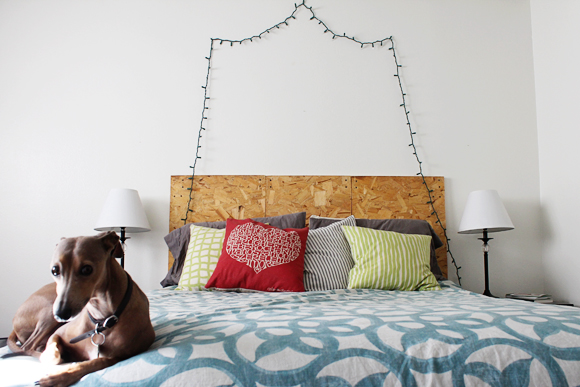
DIY Plywood Headboard

DIY Plywood Headboard


DIY Plywood Headboard

I love the deconstructed concept and the pattern and texture the particles of wood have. The warm, cheery tone also plays well with the pillows and comforter. I know that it’s definitely not going to be everyone’s cup of tea, but I decided if I couldn’t afford a real, grown up headboard right now, to head in the totally opposite direction and do something funky and exciting. I mean, I’m not getting any younger, right?

Now the big question is… what to hang over the headboard? Ideas? 

PS: More OSB love here… In all truth, I found that article through Unhappy Hipster.

The Machine that lets Authors DIY

I have alluded to it a little, but I’m going to take this time to elaborate on my “other” job. As you might know, I’m working retail at Sur La Table, which is a lot of fun but not a full-time gig. To pick up a bit of the slack from not working a 40-hour week I have been working with my mom formatting manuscripts for authors who are interested in self-publishing.

What does that even mean?

First let me show you the book-making machine:

The Espresso Book Machine

This machine will print the cover and the pages, affix the pages to the spine, wrap the cover around, then chop them into a perfect softcover custom book. All in a matter of minutes.

Amazing, right?

My mom had been working with this program, called Flash Books, for quite a while before leaving to take a full-time load of coursework for her graduate program. The popularity of the book-making machine has increased since then, and because she left on good terms, they have been offloading some of the formatting work onto us. Basically I take the manuscript and change all the settings so it will print properly on the book machine. I will also adjust font, add page numbers, table of contents, headers and footers–anything it takes to get the book ready to print. I have two projects under my belt now and after holding the finished copy in my hands I am so excited to take on more clients!

Getting picked up by a major publishing house is really hard, since they are really selective. This makes it easy for any author to realize the dream of holding their own book in their hands. Some authors write memoirs and print them to pass along to children, grandchildren, or other relatives. Others sell them for $10-$15 at book fairs and make a minor profit (it costs $8 to print a book). Some who do want to get published by a large company print their book through Flash Books in hopes of getting it picked up.

It is enjoyable for me since I have always been a formatting freak–often obsessing about the appearance of my college papers and essays rather than the content. Whoops! It has also been a great opportunity to learn more about what the newest version of what Microsoft Word has to offer–which is a lot!

Here is a cool article the area newspaper ran about the DIY Book Program last summer.

Overall this has been a cool opportunity and I can’t wait to help more clients!

Faking a Sofa Table

Sometimes you have awkwardly large items you need to store, and no place to do so. In our case, two large speakers and two bar stools. Where to put them? One option is to get rid of them, but I really, really love these bar-height stools and look forward to using them in a future home, once we’ve moved on from our current apartment. The speakers will be cool when hooked up to a turntable someday (unfortunately, the turntable we have does not have any output capabilities except the speakers in its unit) so we’re holding on to those for the future as well.

That said, when you’re dealing with just over 800 square feet, every space must be maximized to its full potential. There is no spare bedroom, basement, or garage to hoard items in–which is quite the learning curve for my since the last place we lived had all three of those hoarding storage solutions.

I really (really, really, really) like the console table that John built to go behind the Petersik’s sofa in the living room over on Young House Love. It has a ton of hidden storage and adds a lot of dimension to the room. I thought perhaps I could take a clue from that and come up with some kind of storage/hiding place solution in our apartment! All it took was a little brainstorming and one pre-finished shelf board at Home Depot.

I love the look that a sofa table adds to a room. It gives the space much more dimension than just having the couch shoved up against the wall and in the corner.

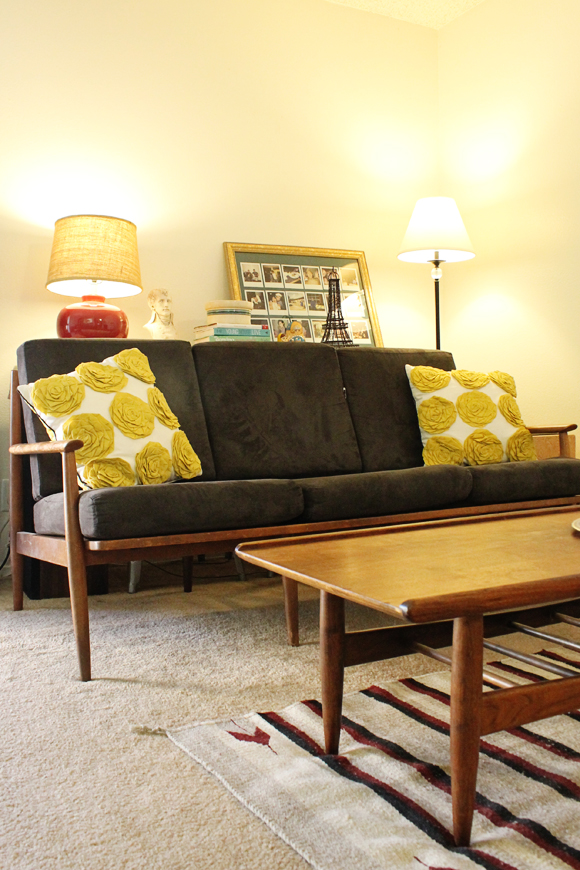
The finished product:

The untrained eye would never guess what is going on behind the couch! It is a fantastic place to keep some of my more attractive (and more frequently thumbed-through) design books, a few pretty tchotchkes, and a much-needed lamp. It also provides an alternative place to put snacks and drinks while watching TV, since the coffee table is simply too dog-accessible.

And a peek behind the curtain:

The cloth runner (from Target) is up there for two reasons: a) it looks pretty, and b) the shelf board is a little shorter than I like so this hides that awkward fact pretty well.

If I ever get around to it, another shelf board slid on to the lower bar stool rungs will be a great addition for a little bit more concealed storage.

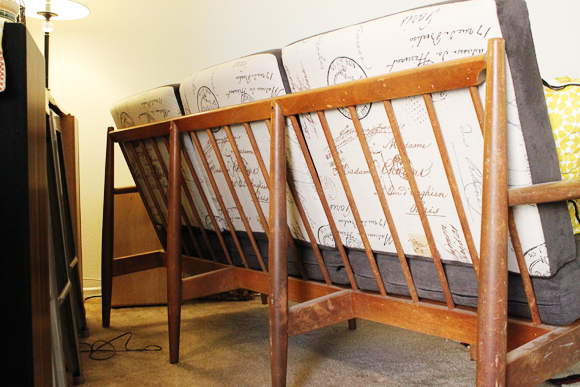
And a bonus shot, with a little explanation:

I realize I never showed the world the back of the couch cushions! When we purchased the gray microsuede for our upholstery, it was a remnant and about a yard short of the needed amount to cover all the cushions. We went ahead and selected an inexpensive contrasting canvas printed with french postmark stamps (I think?) to make up the difference. So far we have been able to arrange the furniture so that it remains hidden.

Now you know our (not so dirty) little secret! Have you ever gotten creative with something like this? I bet they do a lot of creative “faking it” for furniture on TV and movie sets, don’t you?