“The Book of Unknown Americans” Book Review and September Selection!

My sister picked this month’s book, The Book of Unknown Americans, and I was really excited to read it because it came with so many accolades—from NPR, The Washington Post, New York Times, etc. Since this is a virtual book club, we have been posting our responses online at the end of each month. You can read Libby and Stephanie’s responses on their blogs live right now!


I studied a lot about international affairs, immigration, and the like when I was in college. I’ve read so many articles about how hard it is to immigrate to the U.S. so I thought I had an idea what it is like for people who come here looking to escape a bad country or seek a better life for their family. I was blown away by the way Cristina Henríquez took issues you read about in the newspaper and attached a person or a family to the story, and for this reason I think the book is hugely important.

The structure of the book jumped from person to person, and occasionally backtracked, allowing a character to describe events that had just happened from a new point of view. I really loved this. All of the characters in this book live in a small apartment complex and have immigrated to the U.S. from a variety of Latin-American countries. One of the points of this book was to show the reader the wide variety of reasons one would leave their home country. It’s a real dose of perspective and empathy.
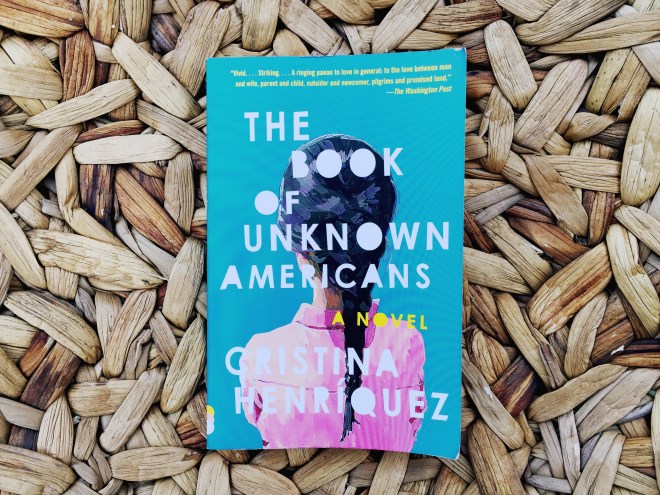
The Book of Unknown Americans

The main plot of the book is that the Rivera family, who applied for visas to come to the U.S. and waited years, has finally been approved. They sell or store everything from their home in México and arrive in Delaware in the back of a pickup truck. They move into the apartment building and slowly meet their neighbors. The Riveras’ high-school aged daughter, Maribel, has suffered a brain injury in México and she is the whole reason they came north—so she could be admitted to a special education school to help rebuild her short term memory and other issues caused by the accident. There is a nerdy, high-school aged boy in the complex, named Mayor: he sees himself and Marisol as outsiders and the two form a special friendship, which turns into a clunky, confused, first-romance.

Like many highly lauded books, this one has a really tragic final act, and the sting is only slightly soothed by the Latin American community coming together as a kind of extended family at the very end. What is it about humans that tragedy is often the only thing that will jolt us out of our normal thoughts and routines?

I highly recommend this book to anyone, and I probably wouldn’t hesitate assigning it to a college class (the topic is on my mind since I work at a school and have seen my fair share of freshmen on the edge of adulthood this week). I don’t know if I mentioned it before, but over the past three years I’ve been making a great effort to read books written by non-whites from a variety of countries (the U.S. and abroad) and it has been so, so, rewarding. Not only do publishers need to continue the breadth of their author pool, reading those authors has been expanding my world in a way that makes me feel like I know so little (but in a good way).

Virtual Book Club


Next up, lighter fare. So happy that we are going to read Mindy Kaling during my birthday month! Buy Why Not Me in a physical copy or kindle version and join Libby, Stephanie, and me the last Wednesday of September when we discuss on our respective blogs.
Mindy Kaling

“The Secret Life of Bees” Book Review and July Selection! 

It’s the best part of the month—book club time! I’ve been having such a good time reading along with Libby and Stephanie, and you if you’d like to join. If you’ve ever read this book (even if it wasn’t this month) I’d love for you to join in the discussion in the comment section! Our club has been all over the place in the last three months. Paranormal, then sci-fi, and now a touching civil rights-era story set in the South.

The Secret Life of Bees by Sue Monk Kidd is one of those books that I’d always heard buzz about (yes, I just went there) but I literally had no idea what it was about or when it was published. We democratically decided that it sounded like a good choice, and I zipped over to the used book store and grabbed my copy without so much as looking at the back. So, that’s how I blindly jumped into this month’s read! I was not prepared to be so inspired! As the main character, Lily, runs away from an abusive father and discovers her new, empowered, free, self in the home of three strong, loving women, I was inspired to be the person (like the Calendar Sisters) reaching out and raising up those younger than me in need. I work with college students and I am always trying to encourage them to think about their career goals when faced with dumb and mundane college-related decisions. I also try to encourage students to be their independent, best selves. Hopefully my reassuring words have stuck with a couple of them!

The rest of the review contains spoilers and a couple of them are a bit depressing, but I think I found the light at the end of the tunnel: 

One thing I noticed when reading was that I was always holding my breath waiting for something big and bad to happen. This gave me an uneasy sense of suspense for most of the book, instead of soaking in the warmth of the Calendar Sisters and the pink house. This should not have been a “suspense” novel! Honestly I want to reread this soon so that I can savor it more the second time, since I now know what is coming and when. May’s suicide and the arrest of Zach definitely qualify as “big, bad” things, but I’d psyched myself out so much, expecting the worst (I pictured Zach getting beaten to death for spending so much time with a white girl) that the bad things that actually did happen in the book didn’t really shake me. And I think this is a commentary on the extremism of books and movies, and media for that matter:

Devastating things happen in TV and books, and in real life on a regular basis—so regular in fact that some of them have a hard time registering as a blip on the radar. (Oh, only a couple people died? Not 20?) This reminds me of May, who felt everything so deeply that she had to take it to the wailing wall. I find myself somewhere in between praying the common prayer, “break my heart for what breaks yours,” and frequently shutting down so I don’t get overwhelmed with the state of the world. Hate crimes, terrorism, poverty, and the like are so prevalent and with the internet we have an unending source to read more and more about terrible things. Like an IV of tragedy. At some point it needs to be shut off before we, like May, can’t take anymore.

I think that is where supportive groups of people come in. I don’t strictly mean “support groups” although that is one form of important community—but any close circle of friends where you can get “real” without feeling like you are going to freak people out. This can be a church or social group, online community, family, or it can take another form. In the book this took the form of the eclectic, lovely Daughters of Mary. What I learned from the Daughters of Mary is that community can help pull us through whatever the world may have for us, whether it’s something that affects us directly, or if it’s general despair and helplessness about current events.

Oh, and during the part where August tells Lily everything she’s been dreaming of hearing about her mother? The good and the bad? Cut to me silently weeping next to a stranger on an airplane. And when the women stand up for Lily so that she can stay at the pink house? I was beside myself. I’m so glad that the book ended on an “up” note and not on a “down” note. Sometimes we really need those happy endings in life.


Virtual Book Club

Shakespeare and Company

Next month we have selected a really short one: We Should All Be Feminists by Chimamanda Ngozi Adichie. Despite the low page count I am sure there will be lots to unpack during the last week of August. Please join in!

* In order to work incrementally towards my start-up, I have decided to start using Amazon Affiliate links in some of my posts. Thanks for understanding. *

“Ready Player One” Book Review & June Selection!

YES! I haven’t read a book that pulled me in and kept me turning the pages like this since The Hunger Games. Now, I realize that is a bold statement to make, so I’ll work on backing it up without giving too much away.

This post contains Amazon affiliate links.

book-club

There are a few things that I love in books that are all present in Ready Player One, including:

  • Friendship amongst youngsters
  • Taking place in the future
  • Adventure and strategy
  • David vs Goliath themes

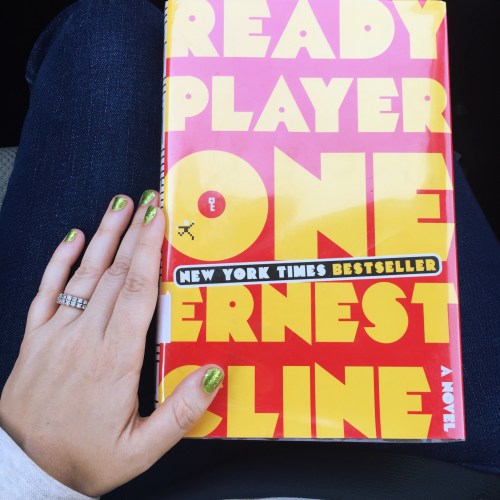
Ready Player One

So, the premise of the book is that the world of the future is such a horrible place that everybody spends the majority of their time in a free-to-access virtual reality world called OASIS. This VR world began as a gaming console then expanded to include socializing, school, and shopping. As a result of this, the inventor of the system became the richest man in the world– and also an eccentric hermit. When he dies, he reveals that there is an “easter egg” in the OASIS that will reward the first finder with the whole inheritance. To find the easter egg, it’s like a scavenger hunt with 80s pop culture as the clues. Oh yeah, and video game battles.

I’m not a “gamer”in the way that actual gamers would give me the title, but I’ve had my toe in geek culture enough to really get into this book. I know enough people that have been into D&D and WoW that I get the concept, and I’ve played a fair amount of Final Fantasy in my day. This said, I don’t think that the heavy amount of geek culture and 80s references will come as a roadblock to anyone who tries to read this book—it is accessible even if you don’t get all the “secret language.”

The most compelling part of the plot, and I think many would agree with me, is that the main character, Wade, and his VR best friends (who he’d never met in real life) are essentially racing against a giant corporation whose sole purpose is to find the egg so they can control—and begin charging subscription fees to—OASIS. Especially considering the current political landscape of, well, the world, this theme really grabbed me. As the race to find the egg ramped up, so did my impatience to finish the novel and I stayed up late on many nights to finish it. The themes of us little people vs. large companies, and that of close friends that have never met in the real world, are ones I think a lot of us can connect with in this age where we spend so much time online. Perhaps the OASIS is not as far-fetched as it sounded at first…

I would LOVE to read your reaction. Libby and Stephanie will be posting their reactions too so make sure to find out what they thought! Have you read this or are you planning to? Please leave a comment!


Now, I can announce the June book choice—The Secret Life of Bees by Sue Monk Kidd. This has been on must-read lists for over a decade… Libby and Stephanie and I were talking about how none of us had ever read it. So, by the end of June, I’m sure we’ll all be able to cross it off of our reading list! Please read with us? Join our little club?